Retail Traders Use AI to Spot Prediction Market Glitches and Make Easy Money
Discover how AI is helping retail traders exploit prediction market 'glitches' to earn profits. Learn about ai trading tools and retail ai solutions.
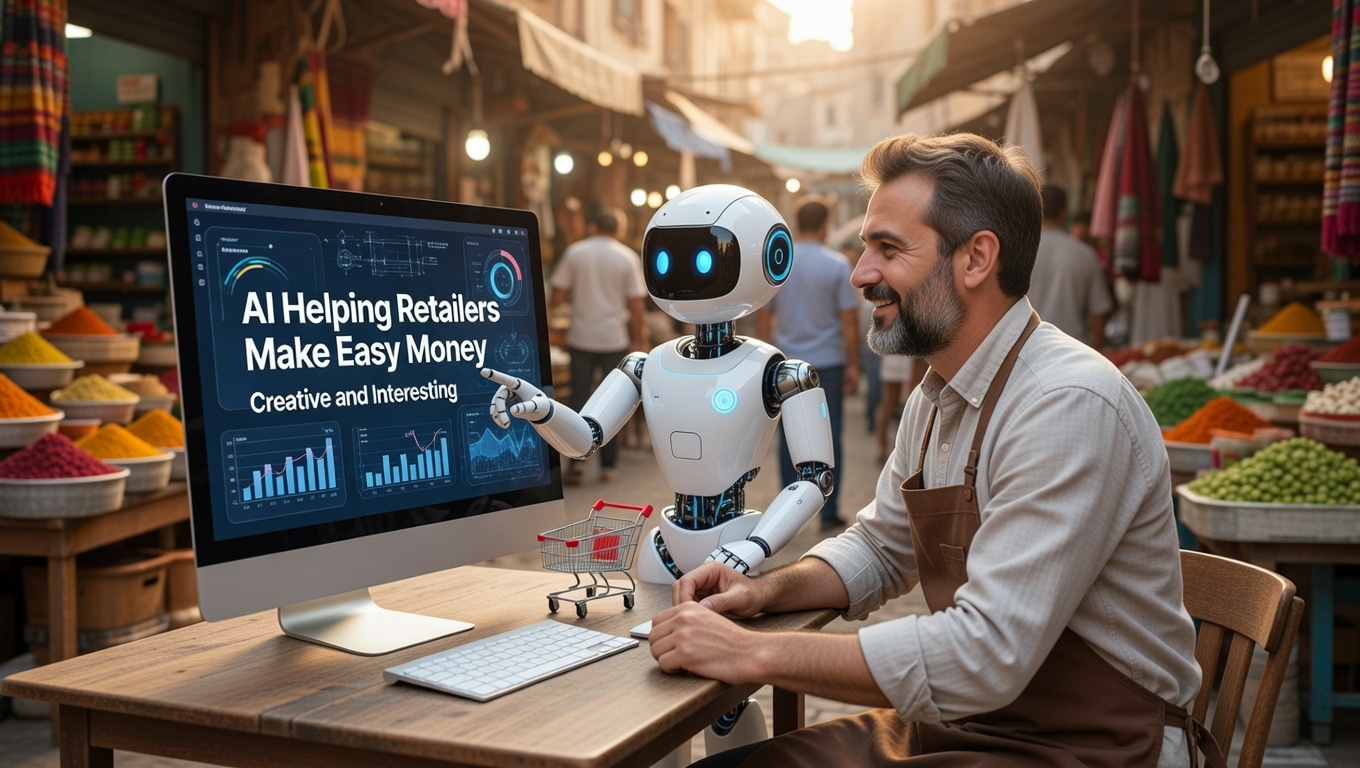
AI is helping retail traders exploit prediction market 'glitches' to make easy money
For decades, Wall Street's biggest players have used supercomputers to gain an edge—a game most of us could only watch from the sidelines. But that’s starting to change. Armed with surprisingly accessible AI tools, everyday people, or "retail traders," are now finding and exploiting loopholes in niche online markets to turn a profit.
The secret to their success is what they don't do. They aren't trying to guess if a company's stock will rise or fall. Instead, their strategy ignores the final outcome entirely. They profit from tiny, fleeting "glitches" in the system—momentary price differences that appear and vanish in the blink of an eye, completely unnoticed by most participants.
This new financial game isn't played on the New York Stock Exchange. It's happening on unique platforms known as "prediction markets," which operate like a stock market for real-world events. Here, you can buy and sell shares based on whether you think a movie will be a blockbuster or a specific candidate will win an election.
Catching a profitable glitch in these fast-moving markets is virtually impossible for a human. This is precisely how AI is helping retail traders find their advantage. Their automated tools watch multiple markets at once, instantly capitalizing on price differences to lock in small profits. This shift marks a fascinating new chapter for AI in trading, empowering individuals with a clever strategy that was once the exclusive domain of giants.
What Are Prediction Markets? The Stock Market for Real-World Events
At their core, prediction markets are exactly what they sound like: a stock market for real-world events. Instead of buying a share of a company like Apple, you buy “shares” in a specific outcome. For example, on a market asking, “Will this new superhero movie be #1 at the box office this weekend?” you could buy either “Yes” shares or “No” shares. It’s a powerful way for a crowd to pool its collective knowledge and put a price on what it thinks will happen next.
Here’s where it gets clever. The price of these shares always trades between $0.00 and $1.00, and that price acts as a real-time probability forecast. If a “Yes” share costs $0.70, the market is signaling a 70% chance that the event will happen. If you buy a share and the outcome you chose occurs, your share becomes worth a full $1.00. If you’re wrong, it becomes worthless.
This ability to trade at any time is what separates prediction markets from a simple, locked-in bet. Let's say you buy “Yes” shares at a low price of $0.30. A week later, a rave review comes out, and the price jumps to $0.60 as more people become confident. You don't have to wait for the movie’s release; you can sell your shares right then and there for a profit, just like with a stock.
Major platforms like Polymarket and Kalshi host thousands of these markets, on everything from election results to the release date of a video game. But the retail traders using AI aren’t necessarily trying to predict these outcomes. Instead, they’ve found a loophole within the system itself—a fleeting “glitch” that allows them to make money regardless of who ultimately wins or loses.
Finding the 'Glitch': Where Does the 'Easy Money' Actually Come From?
If these tech-savvy traders aren't trying to predict the future, where is the money coming from? The secret isn’t about being right; it’s about being fast. The "glitch" they exploit is simply a temporary price difference for the exact same event across two or more separate prediction markets. Think of it as the digital equivalent of finding a brand-name gadget for $50 on one website while it’s still listed for $60 on another. For a brief moment, the same item has two different prices.
These price gaps happen because of speed. Imagine a major movie critic suddenly tweets a rave review for a film. Traders on Market A might see it instantly and rush to buy “Yes” shares, pushing the price from $0.50 up to $0.60 in seconds. But over on Market B, the crowd is a little slower to react. For a fleeting moment, its price for the exact same outcome lags behind, still hovering at the old $0.50 price. This creates a temporary, 10-cent imbalance between the two markets.
Crucially, this window of opportunity is incredibly brief. Markets are designed to correct themselves, and other traders will quickly spot the lagging price on Market B, buy up the cheap shares, and close the gap—usually within seconds. The glitch vanishes almost as fast as it appeared. For a human, trying to manually spot this difference and place trades on two separate websites is practically impossible. It’s like trying to catch a specific raindrop during a downpour.
This is the moment the whole strategy hinges on. For that split second, a “Yes” share can be bought for $0.50 on Market B and sold for $0.60 on Market A. By buying the cheap share and selling the expensive one simultaneously, a trader can lock in a small, guaranteed profit, no matter how the movie actually does at the box office. They aren't betting on the film; they are betting on the price difference. But since no person is fast enough to execute this manually, it raises the obvious question: how do they do it?
How AI Acts as a Super-Fast Assistant to Catch These Glitches
This is where human reflexes hit their limit. Imagine trying to monitor half a dozen live TV channels at once, waiting for a single, specific word to flash on screen for a fraction of a second. You’d blink and miss it. For a retail trader, trying to manually watch multiple prediction markets for these fleeting price glitches is the same impossible task. The opportunity is often gone before you can even move your mouse.
Instead of trying to do it themselves, these traders deploy specialized AI trading tools—essentially, super-fast assistants that never sleep. This automated bot has one simple, round-the-clock job: connect to multiple prediction markets and watch the prices for the exact same event. It isn't thinking or predicting; it’s just following a very clear instruction: “When the price for 'Yes' on Market A is higher than the price for 'Yes' on Market B, flag it immediately.”
But simply flagging the opportunity isn’t enough. The tool’s real power is its speed of execution. The instant that profitable glitch is detected, the program can execute the two-part trade in milliseconds—far faster than any human could click. It simultaneously buys the cheap share and sells the expensive one, locking in that tiny profit before the broader market even has a chance to notice and correct itself. It’s this combination of constant monitoring and lightning-fast action that turns a theoretical loophole into a practical strategy.
The Anatomy of an AI-Powered Trade: A Step-by-Step Walkthrough
So, how does the AI actually turn a split-second price difference into a guaranteed profit? It’s not about predicting the future; it’s about executing a perfectly balanced, two-part trade. The strategy is surprisingly simple in principle, but it relies on the AI’s inhuman speed to work. By the time the trade is complete, the outcome of the event no longer matters.
Imagine two different prediction markets are both trading on the question: "Will this summer blockbuster be #1 at the box office?" For a moment, a price glitch appears:
-
On Market A, a "Yes" share costs $0.75 (meaning the market thinks there's a 75% chance).
-
On Market B, the "Yes" share is lagging behind and only costs $0.70.
A human would never catch this. But for the AI, this is a glaring green light. In less than the blink of an eye, it executes a precise, three-step maneuver:
-
SPOT: The AI sees the price difference between the two markets.
-
BUY CHEAP: It instantly buys the "cheap" $0.70 "Yes" share on Market B.
-
SELL HIGH: Simultaneously, it goes to Market A and buys a "No" share for $0.25. Buying "No" for $0.25 is the perfect counter-move to selling "Yes" for $0.75, effectively locking in that higher price.
Now, look at what the AI has done. It spent a total of $0.95 ($0.70 for the "Yes" share + $0.25 for the "No" share). Because one of those outcomes must happen, one of those shares is guaranteed to become worth $1.00 when the event is over. The trader’s profit is the difference: $1.00 minus their $0.95 cost, for a locked-in gain of 5 cents.
This is the key. The trader is no longer betting on the movie's success. They are holding both a "Yes" and a "No," making them indifferent to the outcome. Their profit comes purely from exploiting the temporary price gap between two markets. But if each trade only makes a few cents, is this really the path to riches it sounds like?
Is This Really 'Easy Money'? The Hidden Risks and Realities
The idea of a bot making hundreds of tiny, guaranteed profits a day sounds like a dream. But while the logic is sound, the reality is far from a risk-free path to riches. The world of automated trading is littered with trapdoors, and these AI-powered strategies are no exception.
For one, these golden opportunities don't last forever. Think of a market "glitch" like a newly discovered shortcut on a busy highway. The first few drivers who use it save a lot of time. But as more people find out, the shortcut gets congested and soon becomes just as slow as the main road. Similarly, as more bots flood the system looking for these temporary prediction market inefficiencies, the price gaps close faster, shrinking from seconds to milliseconds until they practically disappear. The party gets more crowded, and the free drinks run out.
Beyond the shrinking opportunities, there's also the constant threat of technical failure. What happens if your bot successfully buys the cheap "Yes" share, but your internet connection blips before it can buy the balancing "No" share? Suddenly, you're not holding a guaranteed profit—you're holding a simple, risky bet on the movie's success. This is one of the biggest risks of AI trading in prediction markets; a perfectly safe strategy can become a gamble in an instant due to a simple glitch in your own setup.
Finally, the platforms themselves introduce uncertainty. The rules for how a prediction market settles a question can be surprisingly subjective. What if a movie's release date is delayed, or a political candidate drops out? How the market operators decide to resolve these ambiguous events can instantly invalidate a trade that seemed like a sure thing. The AI might be flawless, but it's still playing in a human-run sandbox, and the rules can change without warning.
What This All Means: Are We Heading for a Future of AI Traders?
Before, the world of automated trading might have seemed like a fortress, accessible only to Wall Street firms with supercomputers. Now, you can see the clever backdoors—the small, fleeting glitches in niche markets that everyday traders are starting to exploit. You’ve peeked behind the curtain to understand how modern AI in trading actually works on a human scale.
This phenomenon is bigger than just one easy trick; it signals a shift where powerful retail AI solutions are becoming more accessible. As these tools get more common, the advantage won't come from simply using a bot. The real, lasting skill will be the creativity to spot the next inefficiency—the next market ‘glitch’ that no one else is looking for yet.
So, the next time you read about AI disrupting an industry, you'll recognize this pattern. It's no longer just a story about big institutions getting richer. It's also the story of a quiet revolution, where individual cleverness, armed with accessible tech, can carve out its own space. The future of trading isn't just about who has the most money, but increasingly, who has the most creative idea.