Iran Crypto Volume Drops 80%, What TRM Labs Says It Means
From Feb 27 to Mar 1, 2026, Iran's crypto trading volume fell by about 80%. That headline number sounds like a sudden collapse in demand. TRM Labs, a blockchain intelligence firm, says it's more complicated.
Iran Crypto Volume Drops 80%, What TRM Labs Says It Means
From Feb 27 to Mar 1, 2026, Iran's crypto trading volume fell by about 80%. That headline number sounds like a sudden collapse in demand. TRM Labs, a blockchain intelligence firm, says it's more complicated.
Even if you've never bought Bitcoin, this matters. In Iran, crypto often acts like a backup payment rail when banks, cards, and cross-border transfers don't work well. When crypto activity freezes, real-world commerce can freeze with it, from small importers to families trying to protect savings.
So what happened here, a true demand crash, or a situation where people simply couldn't access markets? Below is what TRM Labs says drove the drop, what the signal likely means (and doesn't), and what to watch next as March 2026 unfolds.
What actually caused Iran's 80% crypto volume drop, according to TRM Labs
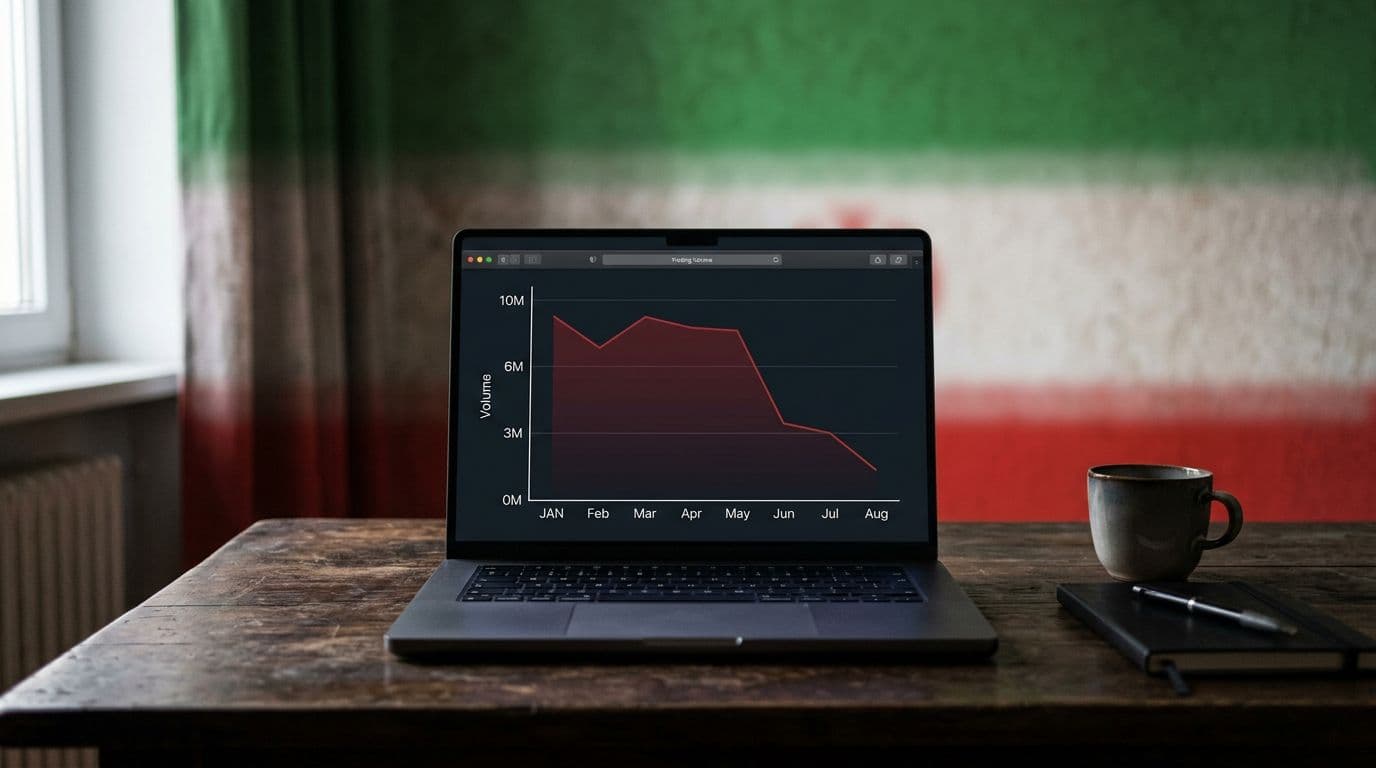 An illustrated view of a sharp volume decline tied to Iran-specific conditions, created with AI.
The timing matters because the fall happened fast, not over weeks. TRM Labs linked the drop to a stack of short-term shocks that can drain volume without proving people stopped wanting crypto. Think of it like a busy store during a storm. The shelves may be stocked, but if roads close and power cuts out, sales plunge anyway.
In TRM's read, two forces lined up: a sudden security crisis and tighter local constraints around access and trading pairs. Some of the biggest Iranian exchanges reportedly remained online, yet activity still thinned out sharply. That "online but quiet" pattern is a clue. It suggests friction, not only sentiment.
TRM also described exchanges operating in tighter "risk-controlled" conditions, which tends to thin order books and reduce churn. When markets get jumpy, platforms and users both pull back. Traders place fewer orders. Spreads widen. People wait for clearer signals. Volume drops before any price chart tells a story.
For TRM's own write-up and context on how conflict can affect market activity hour by hour, see TRM's analysis of Iran's crypto market reaction.
War shock plus internet limits can freeze trading even when exchanges stay online
 Connectivity disruptions can turn a liquid market into a waiting room, created with AI.
A major jolt hit on Feb 28, when U.S.-Israel strikes triggered fear and rapid uncertainty. Reports around the event included claims of top-level casualties, which only added to panic. In moments like that, people don't trade like usual. They pause, rush to move funds, or go offline entirely.
Internet disruption is the simplest explanation for a sudden volume cliff. If users can't connect, they can't trade. Even partial throttling can do damage because trading needs steady access to price quotes, logins, and confirmations. If you can't reliably load the app, you don't place the order. If you can't see a price, you don't know what you're agreeing to. If banking rails slow, deposits and withdrawals stall.
When a country loses reliable connectivity, crypto volume can fall for "plumbing" reasons, even if interest in crypto stays high.
TRM pointed to widespread outages and access restrictions around that period. That lines up with the "exchanges stayed up but trading dried up" dynamic. A marketplace can exist, yet still feel unreachable.
Policy moves mattered too, like limits on USDT-rial pairs
Before the strikes, Iran's Central Bank reportedly ordered major exchanges to stop offering USDT-rial trading pairs. That kind of rule can cut volume immediately because USDT often serves as the bridge asset. People use it to park value, transfer funds, and move between crypto and local currency.
When you restrict a popular on-ramp, you don't need a price crash to see volume fall. Users who would normally buy USDT with rials may not have a clean path. Market makers who depend on that flow can also step back, which reduces liquidity for everyone else.
This is also why "volume down" doesn't automatically mean "crypto abandoned." It can mean the easiest route got blocked. For more background on Iran's official relationship with stablecoins and USDT-related activity, see reporting on the Central Bank and USDT's role in supporting the rial.
What TRM Labs says the drop means, and what it does not
 Monitoring tools can show whether volume returns once access and rules stabilize, created with AI.
TRM Labs' core point is that the 80% drop looks driven mostly by mechanical access issues, not a sudden, lasting collapse in crypto use. That distinction matters because many headlines treat volume as a pure "demand gauge." In reality, volume is also a measure of how easy it is to transact right now.
TRM's framing also fits what people often do in crises. They don't constantly trade. They try to secure access, check balances, and move funds to safer places. That produces fewer trades on local order books, especially when the internet wobbles and rules tighten.
At the same time, TRM doesn't claim "nothing happened." It argues the volume crash alone isn't proof that Iranians stopped using crypto. The drop can reflect a short-term freeze, especially during a three-day window where fear and access problems overlap.
A volume crash can be a plumbing problem, not a change in demand
"Mechanical access issues" sounds technical, but it's basic stuff:
- Connectivity: outages, throttling, blocked apps, unstable mobile data.
- Platform access: login trouble, KYC slowdowns, downtime on key services.
- Payment rails: deposits, withdrawals, and bank transfers that don't clear.
- Risk controls: stricter limits that reduce trading frequency and size.
When any of those fail, volume falls. People may still want stablecoins, or still prefer crypto to rials, but they can't transact smoothly.
TRM also noted thinner order books and more cautious conditions on exchanges. Lower liquidity alone can reduce volume because traders avoid big orders that could move price against them.
Why some analysts saw outflows anyway, and how to read that signal
Other researchers highlighted movement in the opposite direction: funds leaving local venues. Elliptic, for example, reported a sharp spike in outflows from Nobitex, including a figure around $10.3 million moving quickly after the strikes. Elliptic's summary is here: Iranian cryptoasset outflows surge 700% following airstrikes.
Outflows can mean several things, and not all of them are bearish:
- Some users shift to self-custody during unrest.
- Others move to foreign venues to reduce local platform risk.
- Many rotate into stablecoins as a "cash substitute."
Still, outflows don't prove the whole market is dead. A crisis can cause both effects at once: fewer trades on local books (volume down) and more transfers out (outflows up). One is about trading activity, the other is about where funds sit.
The balanced take is simple. TRM's "access and plumbing" argument can be true, while fear-driven capital movement can also be real.
What happens next, practical takeaways to watch in March 2026
The early March data only shows the first impact. It doesn't tell us how quickly daily life, banking access, or internet stability will normalize. Still, a few measurable signals can help separate a temporary freeze from a longer slowdown.
Watch for a rebound in volume, stablecoin demand, and more restrictions
Start with indicators that change fast:
- Volume recovery on major Iranian exchanges (a sign that access returned).
- Shifts in USDT usage (a sign of savings behavior and payment needs).
- Renewed internet disruptions (a direct brake on trading).
- New Central Bank rules that limit pairs, withdrawals, or onboarding.
- Stricter exchange risk controls that keep activity low even after access returns.
If connectivity improves, volume can bounce quickly. However, fear and tighter rules can keep activity muted, even with working apps.
Why this matters outside Iran, sanctions risk, compliance, and market resilience
For global readers and US-based compliance teams, Iran-linked crypto flows matter because crypto can function as a workaround when traditional finance is constrained. When local access tightens, flows may reroute to different venues, new intermediaries, or more peer-to-peer activity. That can raise sanctions and counterparty risk, especially for exchanges, OTC desks, and DeFi protocols that monitor exposure.
There's also a broader market lesson: global crypto prices did not show a lasting shock from the Iran-specific volume collapse, at least in the immediate window. That suggests a split reality, global markets can look stable while a local market experiences a sudden shutdown from policy and connectivity.
Conclusion
Iran's 80% crypto volume drop from Feb 27 to Mar 1, 2026 reads less like a sudden loss of interest and more like a market that couldn't function normally. TRM Labs ties the fall mainly to access constraints during a major security event, plus policy friction such as limits on USDT-rial trading pairs. At the same time, outflows reported by other firms can still signal fear and rapid fund movement. Over the rest of March 2026, the clearest tells will be connectivity, new rules, stablecoin activity, and how tightly exchanges keep controls as conditions change.