How to Mine Bitcoin: A Guide to Bitcoin Mining Machines and Strategies
Discover how to mine bitcoin securely with essential steps and equipment. Understand bitcoin mining rigs, pools, and profitability for aspiring crypto miners.
How to Mine Bitcoin
You've probably pictured 'bitcoin mining' as a digital gold rush. But what if its main purpose wasn't finding treasure, but building a fortress? Bitcoin's "work" is the very thing that keeps the network secure.
Imagine a shared public notebook that anyone can view, but no single person or bank controls. Every time someone sends bitcoin, it gets recorded. But with no one in charge, who do you trust to write the next page? What stops someone from cheating?
This is the core problem bitcoin miners solve. Through a massive, worldwide lottery that happens every ten minutes, they earn the right to add the next "page" to the book, verifying everything is accurate. Miners use powerful computers to compete against each other to solve an incredibly difficult puzzle—like trying to be the first to guess a secret number with trillions of possibilities. Their computers aren't thinking; they are making billions of guesses every second.
Finding that winning number is the "proof" that a miner expended real-world effort and electricity. This is the concept behind the Proof-of-Work system. The winner shows their correct answer, and this grants them the right to add the next "block" of transactions to the ledger. This intense, energy-consuming competition is what keeps everyone honest, as it becomes practically impossible for a bad actor to overpower the network and falsify transactions.
How Bitcoin Miners Get Paid: The Digital 'Paycheck' for Securing the Network
But why would anyone spend so much on electricity and powerful computers just to win this puzzle-solving race? For the prize. The miner who successfully proves their work and adds the next block gets a digital paycheck. The bitcoin block reward is the fundamental answer to how bitcoins are generated: by successfully securing the network.
This reward isn’t paid by any person or company. The network automatically awards the winner a set amount of brand-new bitcoin that never existed before. This is the only way new bitcoins are brought into circulation, serving as a predictable and decentralized mint.
Crucially, this reward isn't fixed. About every four years, a pre-programmed event called the bitcoin block reward halving cuts this prize in half. This built-in scarcity makes creating new bitcoin progressively harder over time, much like mining for a precious metal, ensuring its supply is finite and predictable.
What is the Blockchain? Bitcoin's Unforgettable Public Notebook
So where do miners record all these transactions? They’re added to the blockchain, Bitcoin’s official, public record book. This digital ledger contains the history of every transaction, ensuring total transparency for the entire network.
Each "page" in this notebook is a block—a list of recent transactions. After a miner validates a block, it is sealed and digitally linked to the one before it. This process forms an unbreakable chain, which is where the name “blockchain” comes from. Each new block permanently extends the ledger, making it longer and more secure.
This structure is the key to its security. To alter one old transaction, an attacker would have to redo that block and every single block after it while out-competing the entire network. This requires a staggering amount of computing power, making the record virtually tamper-proof.
Can I Mine Bitcoin on My PC? The Reality of Modern Mining Hardware
Thinking about firing up your laptop to try mining bitcoin? A decade ago, that was a real possibility. Today, the global "guessing game" has become so incredibly competitive that a standard PC simply can't keep up. The odds of a lone home computer winning the race are now practically zero.
[Image: A clean, well-lit photo of a single, modern ASIC bitcoin mining machine, a compact rectangular box with large fans on the end, sitting on a metal shelf.]
To have any chance of success, today’s miners use highly specialized hardware called an ASIC miner. Unlike a multi-purpose home computer, an ASIC (Application-Specific Integrated Circuit) is a bitcoin mining computer designed to do only one thing: solve Bitcoin’s puzzle at lightning speed. This single-minded focus makes it thousands of times more efficient than any general-purpose processor.
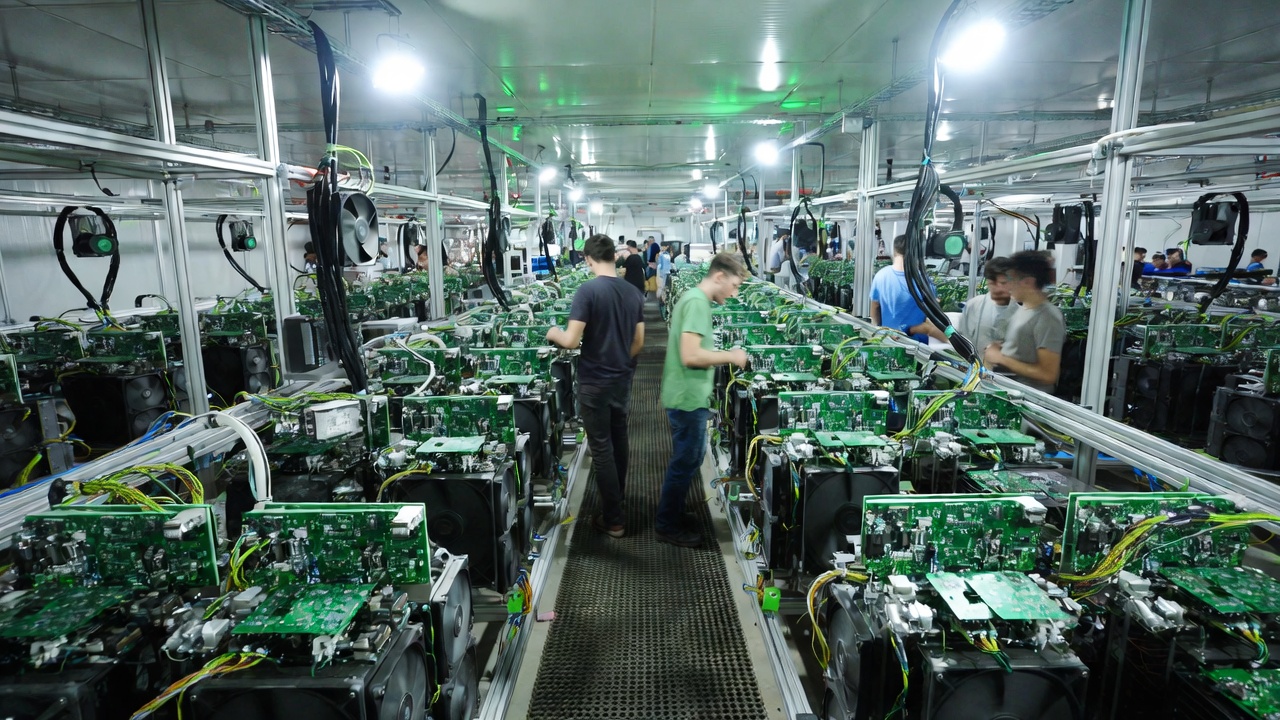
The raw power of one of these machines is measured by its hash rate—the number of "guesses" a miner can make per second. While a powerful PC might make a few million guesses, a modern ASIC miner makes trillions of them. This massive gap is why serious mining has evolved into a large-scale industrial operation.
Why Most Miners Join a 'Pool' Instead of Going Solo
Even with a super-fast ASIC miner, you're still one person competing against a global network. This is called solo mining, and it’s like buying a single lottery ticket for a massive jackpot—the win is huge, but the odds are astronomical. You could run an expensive machine for years and never find a block.
To solve this, the vast majority of miners choose teamwork. They join a mining pool, which combines the hash rate of thousands of miners. In our lottery analogy, this is like an office pool where everyone combines their money to buy thousands of tickets, dramatically increasing the group's chance of winning.
By joining a pool through a miner site, you trade that tiny chance at a huge reward for a guarantee of small, regular payouts. The pool shares the block rewards it wins among all members, providing a much more predictable and stable income stream.
Is Bitcoin Mining Still Worth It? The Real Costs vs. Rewards
For the average person, the answer to 'is bitcoin mining still profitable?' is likely no. The immense cost of specialized ASIC hardware and staggering energy consumption have turned it into a global industry, making it unprofitable for nearly everyone without a massive initial investment.
However, understanding mining is more valuable than earning a single coin. It reveals the invisible engine of work and energy that secures the entire Bitcoin network. You now understand the proof-of-work mechanism that prevents fraud and what truly gives Bitcoin its substance.