Bitmain Antminer L9 16GH in Canada: Specs, Real Costs, and Rental Options
This guide breaks down the Bitmain Antminer L9 16GH in plain language, a popular doge miner in the Canadian market that uses the Scrypt algorithm to deliver its 16GH hashrate; it covers what specs matter, what Canadians usually pay all-in (not just the sticker)
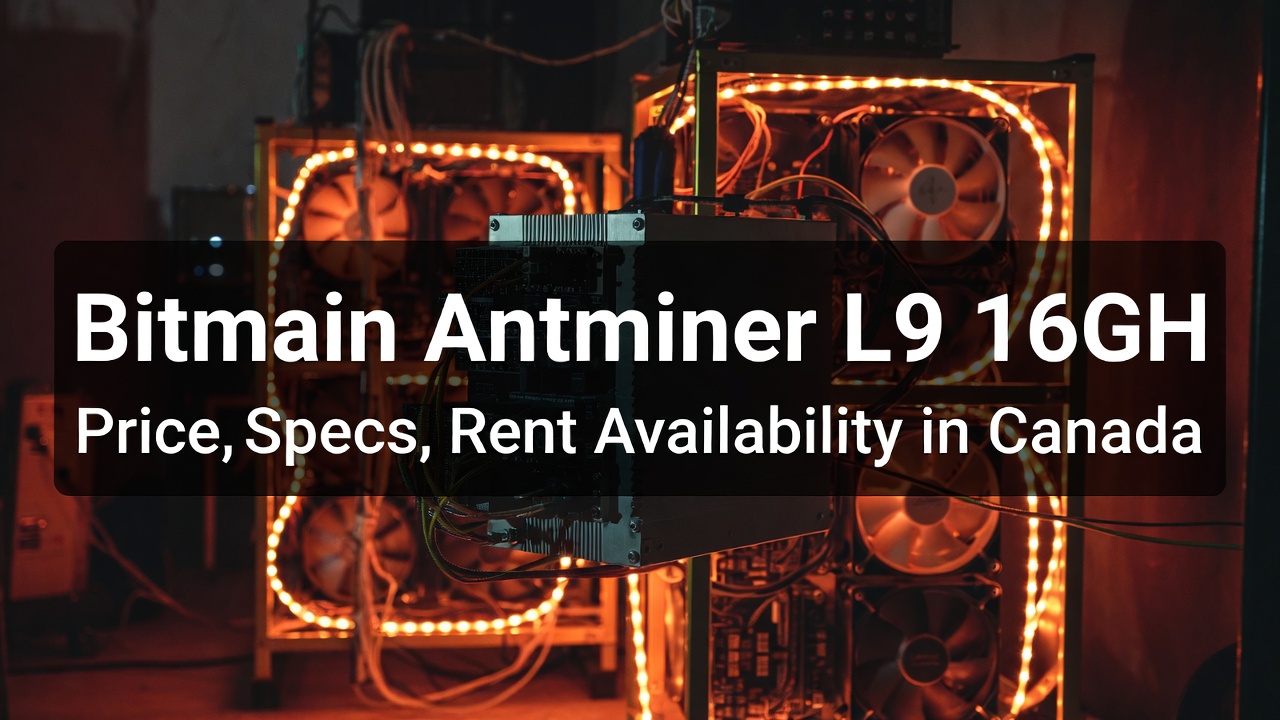
Prices and availability move fast in February 2026. Before you pay anyone, use the checklists later in this post and ask for the proof that matches the exact unit and terms you’re buying or renting.
Antminer L9 16GH specs that actually matter before you spend money
When people talk about “specs,” they often get stuck on one number: hashrate. Hashrate matters, but in Canada, the deal usually swings on power draw, heat, and where the miner will live (your home, a garage, or a hosting facility).
Most listings describe the Antminer L9 as a Scrypt ASIC miner (commonly used for Litecoin and Dogecoin style merged mining). Standard features include cooling fans and RJ45 Ethernet for hardware connectivity. Still, don’t assume every listing is clean or consistent. Batches, firmware, and even replacement boards can change how a unit behaves.
Here’s a simple way to think about the specs that affect your results:
| Spec | Why it matters in Canada | What to confirm before paying |
|---|---|---|
| Advertised hashrate (16 GH/s) | Sets your share of rewards before fees and difficulty changes | Test report showing steady hashrate over time |
| Power draw (3360W) | Your largest ongoing cost if you run it yourself; power consumption adds up fast | Real wattage at the wall, not just a spec sheet |
| Efficiency (0.21 J/MH) | Tells you how much power you burn for each unit of work | Efficiency at your chosen performance mode |
| Noise (75 dB) | Can be a deal-breaker in condos, rentals, or shared homes | Fan type, fan speed behavior, noise complaints history |
| Heat output | Heat is just power turned into warm air | Venting plan, room temps, summer cooling needs |
| Electrical requirements | Wrong circuit equals tripped breakers (or worse) | Voltage range, plug type, dedicated circuit needs |
Compared to its predecessor, the Antminer L7, the L9 delivers a major performance jump. Treat any listing without a recent test report like a used car with no odometer. It might be fine, but you’re taking on extra risk.
Hashrate, power use, and efficiency, how they impact your monthly costs
Hashrate is how fast the miner can do the work for its network. With the Antminer L9 16GH, the “16GH” is the headline number. In practice, your paid hashrate can vary due to temperature, tuning, and how the pool reports shares.
Power is where the math gets real. Electricity is billed in kilowatt-hours (kWh). If you know the miner’s 3360W draw, you can estimate monthly power cost with a simple back-of-the-napkin formula:
Monthly kWh ≈ (3360 ÷ 1000) × 24 × 30
Monthly power cost ≈ monthly kWh × your $/kWh rate
For a quick Canadian reality check, try two rates, like $0.10/kWh and $0.20/kWh, because many people land somewhere in that spread once all fees are included (and some pay more). If the miner draws more than the expected 3360W, that cost climbs every single hour it runs.
Efficiency matters because it connects these two ideas, especially with the L9's strong energy efficiency. Two miners can produce similar hashrate, but the less efficient one eats more power for the same output. Over months, efficiency is often the difference between “this is fine” and “why am I doing this?”
Noise, heat, and electrical setup in a typical Canadian home
ASIC miners aren’t polite roommates. They’re closer to a shop vac that never turns off. If you live in a condo, a basement suite, or anywhere with shared walls, the 75 dB noise level alone can end the project.
Heat is the other half of the story. A miner is basically a space heater that also hashes. In a Canadian winter, you might reuse some heat if you can move it into the right space safely. In summer, that same heat becomes a problem you have to pay to remove, either with ventilation or active cooling.
Electrical setup is where people get burned, sometimes literally. Many high-power ASIC miners are designed for 220-277V AC input and can require a dedicated circuit. Don’t guess. Confirm:
- The miner’s input voltage range and plug type
- Circuit amperage requirements
- Whether a dedicated breaker is recommended
- Safe cabling and a proper receptacle (no bargain adapters)
If you’re not comfortable here, hire an electrician. The cost of doing it right is cheap compared to fried gear or a fire risk.
Antminer L9 16GH price in Canada, what you will really pay all-in
Searching “Antminer L9 16GH price in Canada” usually leads to a wide spread of numbers. That’s because Canadian pricing rarely equals the advertised USD price, and two listings can look identical while hiding very different total costs.
Think of the sticker price like the base price on a car. Your actual all-in cost often includes:
- The miner itself (new, used, or refurbished)
- Shipping (and extra packaging for heavy gear)
- Import taxes and sales tax, depending on how it’s shipped and declared
- Brokerage fees if a courier clears it through customs
- Power supply PSU (if not included or integrated), plus proper power cables such as the P13 power cable
- Spare fans or a backup control board if you want less downtime
Canadian quotes also move with the exchange rate. If a seller prices in USD, your CAD total can change between the day you get the quote and the day your payment clears. Ask how long the quote is valid, and what happens if the FX rate moves. Confirm details like whether the power supply PSU is integrated to avoid surprises.
If you’re comparing offers, compare landed cost (delivered and ready to run) rather than the headline number.
New vs used vs refurbished, which option fits your risk level
The right choice depends on how much downtime you can handle and how confident you are at troubleshooting. Here’s a practical comparison:
| Condition | Upside | Trade-offs | What to ask for |
|---|---|---|---|
| New | Lowest wear, best chance of 180-day warranty | Highest price, still can arrive damaged | Warranty terms, return window, sealed packaging proof |
| Used | Lower upfront cost, faster payback if it runs clean | Unknown history, higher failure risk | Recent hash report, wall power reading, clear board photos |
| Refurbished | Should be tested and repaired | Quality varies by refurbisher | What was replaced, test duration, parts source |
Red flags are usually boring, not dramatic. Missing serial numbers, no test report, hashboards that look swapped, corrosion on connectors, and fans with loud bearings all signal higher risk. Ask for clear photos of boards and connectors, plus a recent run report showing stable performance. The used market stays hot for doge miners, so sellers may skip details under pressure.
If the seller won’t provide basics, assume support won’t improve after they’ve been paid. For refurbished ASIC miners, insist on proof of thorough testing.
Hidden costs Canadians forget, shipping, taxes, hosting setup, and downtime
Even when you buy smart, extra costs show up. Shipping delays can be worse in winter, and the net weight drives up courier costs since heavy boxes don’t always arrive gently. A dead-on-arrival unit is rare, but it’s common enough that your return policy matters.
Taxes and import handling can surprise first-time buyers. Canada’s GST/HST (and sometimes PST) may apply, depending on how and where you buy. Couriers may add brokerage fees for customs clearance. Duties depend on product classification and origin, so ask the seller how they ship and declare the item.
If you plan to host the miner, you may also run into setup costs, like rack space, a PDU allocation, remote hands fees, and minimum contract terms. Then there’s the quiet budget killer: downtime. Repairs, shipping a unit back, waiting for parts, all of it means lost mining time.
A simple habit helps: set aside a small maintenance buffer for fans, cleaning, and surprise failures, and treat uptime as part of the price.
Renting an Antminer L9 16GH in Canada, what “rent” can mean and where to look
“Rent an Antminer L9 16GH in Canada” sounds straightforward, but the word “rent” gets used for very different products, especially for the Bitmain Antminer L9 16GH designed primarily for Dogecoin mining and Litecoin mining. Some offers are true hardware rentals with hosting. Others are hashpower contracts that just pay you based on a promised rate.
In Canada, most legitimate options fall into three buckets:
- A physical miner placed in a Canadian hosting facility (often marketed as hosted mining)
- A lease-to-own plan where payments can convert into ownership
- A hashpower marketplace contract where you buy a slice of hashrate for a set time on platforms like NiceHash or ViaBTC
Where to look? Start with Canadian hosting providers that operate in provinces known for data center and industrial power access. Many facilities cluster where power and space work out, but availability changes, and smaller operators come and go. Wherever you shop, verification matters more than marketing.
You want clarity on who owns the machine, where it sits, who controls the pool settings, and what happens when hardware fails.
Miner rental vs hosted mining vs hashpower contracts, quick pros and cons
A miner rental through a hosting company usually means a real unit is assigned to you, hosted in their facility. You typically pay a monthly rate that includes electricity and service, but read the fine print on repairs and uptime. This setup works well for the Bitmain Antminer L9 16GH in Dogecoin mining or Litecoin mining.
Hosted mining (you own the miner) means you buy the Antminer L9 16GH, ship it to a facility, and pay for power and hosting. You often get more control, but you also take on hardware risk and repair costs.
Hashpower contracts can be convenient, but you’re not renting a specific machine like this doge miner. You’re buying promised output under terms you can’t inspect at the hardware level, with payouts potentially in Dogecoin, Litecoin, or even Bellscoin. Some contracts are honest, others are just marketing with numbers attached.
If an offer calls itself a “rental,” ask one blunt question: “Do I have a serial number assigned to me, and can I change pool settings?”
Questions to ask a Canadian rental or hosting provider before you pay
You don’t need to interrogate providers, but you do need answers in writing. Use this checklist and don’t skip the boring parts:
- Exact model and hashrate: Is it the Antminer L9 16GH, and what hashrate is guaranteed?
- Power rate: Is pricing all-in, or electricity plus service fees?
- Contract length: Month-to-month, fixed term, or auto-renew?
- Setup and deposit fees: Any onboarding charges, shipping handling, or security deposit?
- Payout schedule: Daily, weekly, or monthly payouts, and in what coin?
- Pool access: Do you control mining pool settings, wallets, and worker names?
- Uptime and maintenance: Any SLA, planned downtime windows, and mining pool maintenance policy?
- Repair process: Who pays for parts and labor, and what are the typical timelines?
- Failure rules: If the unit fails, do you get a credit, a replacement, or nothing?
- Insurance and liability: What’s covered if there’s theft, fire, or facility issues?
- Location: Province and city (at least), and whether you can visit or audit.
- Exit options: Can you move the miner, sell it, or end the contract cleanly?
Common scam signals are consistent across Canada: no real address, no serial numbers, pressure to pay crypto only, refusal to provide a contract, and profit promises that sound like a sure thing. Mining is math plus uncertainty, anyone selling certainty is selling something else.
Is the Antminer L9 16GH worth it for you right now? A simple Canada-first decision checklist
The Antminer L9 16GH ASIC miner can make sense, but only when your costs and constraints match this crypto mining machine. The fastest way to regret mining is to buy first and figure out power and noise later.
Use this Canada-first checklist before you buy or rent:
- Confirm your power rate: Use your full delivered rate, not just the base energy price.
- Estimate all-in monthly costs for mining profitability: Electricity (or hosting), pool fees, and a downtime buffer.
- Compare buy vs rent: Buying can cost more upfront, renting can lock you into fees.
- Set a payback window for mining profitability: Pick a time frame you can live with, then stress test it.
- Plan for heat and noise: If it can’t live safely and quietly enough, it won’t last.
- Get serious about records: Track equipment costs, hosting bills, pool statements, and payouts for taxes.
Canadian taxes around mining can get personal fast (hobby vs business, how you report income, how you track expenses). Keep clean records from day one, and talk to a tax pro if you’re unsure. A one-hour consult can save you weeks later.
A quick break-even sanity check you can do in 10 minutes
Online profitability calculators are not crystal balls, but they’re good for fast stress tests on mining profitability. Here’s a simple method:
- Pick a reputable calculator and enter the specs for your doge miner: hashrate (16 GH/s), power draw (from the seller or host), your electricity price (or hosting rate), and pool fee.
- Run it twice with a best-case and worst-case cost scenario, like a low and high $/kWh, or two hosting quotes.
- Then stress test revenue: assume coin price drops and difficulty rises. If the project only works in perfect conditions, it’s not stable.
Treat every calculator result as an estimate. Your real outcome depends on uptime, fees, and market shifts, plus how quickly you can fix issues when something fails.
Conclusion
The Bitmain Antminer L9 16GH ASIC miner can look great on a spec sheet, but specs and sticker price are only part of the story. In Canada, power rates and hosting terms usually decide whether it’s worth running.
Before you commit, collect two to three quotes for both buying and renting, get every all-in fee in writing, and use the provider questions list to pressure test the offer. Ask sellers for a current test report verifying hashrate and performance, and ask hosting providers for the full agreement before paying. If you can’t verify the details, don’t buy the promise.